



Share


Search

result
Seeing the Air We Breathe - Estelle Levetin, PhD, FAAAAI, On 40+ Years of Air Sampling
Seeing the Air We Breathe - Estelle Levetin, PhD, FAAAAI, On 40+ Years of Air Sampling
The AAAAI’s National Allergy Bureau™ (NAB™) is Seeking Pollen Counters
The NAB™ is the nation’s most trusted source for accurate pollen and mold data and is currently welcoming new counters to join its growing network. With a goal of having at least one counter in every U.S. state, the NAB™ is actively seeking new counters in Iowa, Hawaii, Maine, Rhode Island, Vermont and Wyoming.
Becoming certified includes completing a training course (the next session is in August 2026) and successfully passing 2–3 exams. To help you get started, the NAB™ can often loan a pollen sampler, provided you have an appropriate placement location—typically about 60 feet high and free from obstructions.
More than 36,000 public accounts follow at least one NAB station to stay informed about their allergy health. Your participation directly supports patients, clinicians and communities nationwide.
Contact nab@aaaai.org for more information.
Estelle Levetin, PhD, FAAAAI, has been air sampling at The University of Tulsa for over 40 years—but she may not have ever started if it wasn’t for a call from the Allergy Clinic of Tulsa, Oklahoma early in her career.
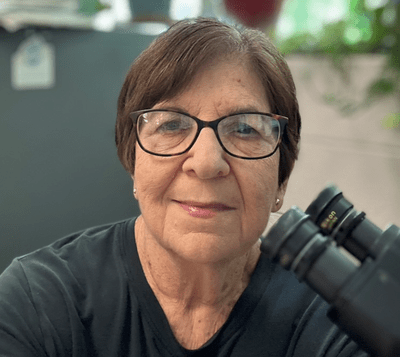
Estelle Levetin, PhD, FAAAAI
“The clinic had heard I was a mycologist working with fungi and asked if I wanted to do a study to see which fungal spores were common in the area,” Dr. Levetin said. “I was a young assistant professor with no outside funding at the time and was ecstatic. I didn’t have a lot of experience with airborne spores so I set up a meeting with the clinic, and in the week leading up to the meeting, read everything I could find on the topic.”
That one-year study in 1976 provided some great data, and Dr. Levetin continued to work with that same clinic for years. “We did mold testing in patient homes in the late 1970s, long before it was common. As time went on, I also got interested in pollen research; in part as someone highly allergic to ragweed myself, and in part with Dr. Paul Buck, the other botanist at The University of Tulsa,” she explained. “Eventually the Allergy Clinic of Tulsa showed me a paper describing the allergy plants in Colorado and asked me to do the same thing for Oklahoma.”
Dr. Buck was a field botanist who knew the local vegetation very well, and they worked together to write a paper on hay fever plants in Oklahoma. In the summer of 1980 it was published, and the two of them decided to start air sampling. “Over the next decade I did more and more studies on airborne pollen, then applied for an NIH grant to study airborne basidiospores. I got the grant which really propelled my career forward,” Dr. Levetin said.
Dr. Levetin has published extensively on airborne pollen and fungal spores ever since, covering topics such as indoor fungal spores, the influence of meteorological factors on pollen, long distance transport of mountain cedar (Juniperus ashei) pollen and much more. For her, the research and air sampling never grow stale.

“There is an incredible abundance and diversity of spores and pollen in the atmosphere once you start looking. Viewing these spores under the microscope is really an eye-opening experience. You get to actually see what it is that is in the air we breathe every day.”

Estelle Levetin, PhD, FAAAAI
Dr. Levetin has trained many students in aerobiology, including presenting at the AAAAI’s Annual Aerobiology Course since the mid-1990s. She’s even had the occasional prospective counter spend a week in the lab with her just to get a head start on aerobiology studies before the AAAAI’s annual course.
Though she retired nearly six years ago, she’s still publishing new research and taking daily air samples. “My husband likes to joke that I work as much as I did before retiring, only now I don’t get paid for it,” she said. “I most recently published a paper on the effect of preseason precipitation and temperature on certain pollen seasons, and I’m a co-author for a textbook, Plants and Society, which is undergoing edits for its 10th edition.”
For many years, Dr. Levetin also maintained an Aerobiology website, which had been hosted on a University of Tulsa server. That server was decommissioned in the late summer of 2024, and she took that opportunity to completely update the website, which is undergoing its final edits right now and will continue to be updated as needed. Although the website is focused on Tulsa pollen and fungal spores, much of the information and images could be useful to counters throughout the country.
Estelle Levetin, PhD, FAAAAI, instructing at the Basic Aeroallergen Course during the 2026 AAAAI Annual Meeting.
When asked how aerobiology has evolved over the years, Dr. Levetin said, “it’s likely that further into the future, a lot of air sampling will be automated, though right now the instruments are extremely expensive and aren’t something an allergist can afford. We’re also seeing more machine-learning analyses able to take air sample data and meteorological data to create accurate pollen forecasts. As this technology grows more accessible and more accurate, I suspect we will see more of it.”
But that doesn’t mean pollen counters will be going away any time soon. “Automated sampling instruments need to be trained,” Dr. Levetin explained. “These devices cannot recognize new pollen or spores in the air. Pollen counters will still be essential for making new discoveries and training these devices so they are able to deliver accurate data.”
No matter how advanced the technology grows, though, Dr. Levetin says there is no replacement for seeing aeroallergens with your own eyes. “To see what is in our air, whether it’s pollen or fungal spores, is such a special feeling,” she said. “To witness the huge variety of aeroallergens and watch how they change during the season is an incredible experience.”